
The savings question,
answered on your site.
SolarCheck is a solar savings estimator for a UK installer’s own website. It finds the roof from satellite imagery, measures it, sizes an array to fit, then values the output using the MCS self-consumption method — so the figure on your site matches the figure on your survey paperwork.
Two lines of code · nothing rebuilt · live in days
On your site it wears your logo and your colours.
Check a real roof.
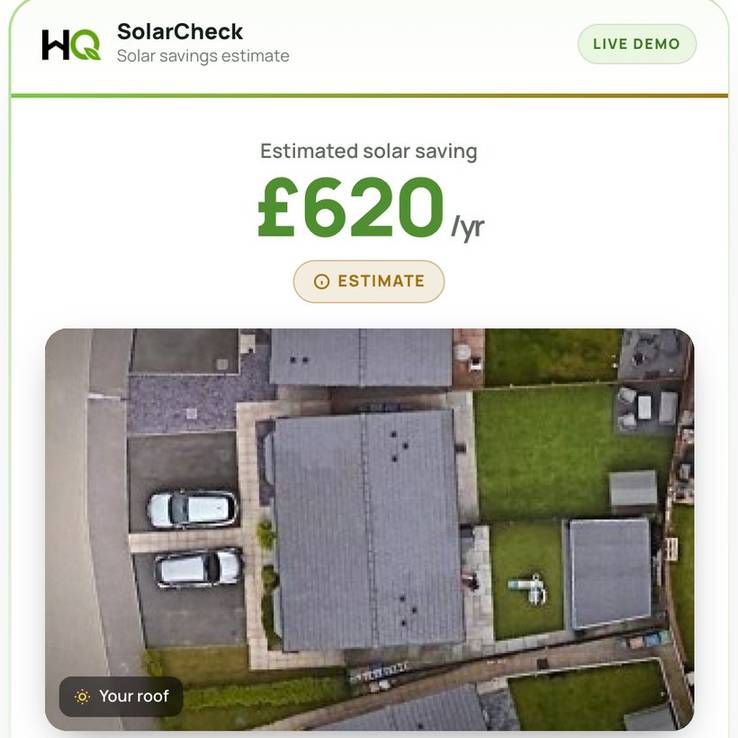
The working checker. Put in any UK postcode, pick the house, and it reads that roof from Google’s survey — the same thing it would do on your site.
Live roof data and 2026 energy prices. Figures are indicative and confirmed at survey.
Watch it read a roof.
A homeowner lands on your website and types a postcode. SolarCheck goes and looks at their actual roof, sizes an array on it, and hands you the enquiry. This is that, start to finish.
- It starts from above
Google’s survey imagery of that address — the actual roof, not a stock photograph of a roof.
- A postcode goes in
One field, then they pick their house from the list. That is the whole ask.
- The roof gets measured
Usable area, pitch and orientation read off the imagery, and an array sized to what it takes.
- Then the enquiry lands
A name, an email and the figure they were actually shown — in your inbox, while they are still interested.
Plays without sound; the captions are on screen. Figures shown are indicative and confirmed at survey.
Rather try it yourself?Thirty seconds, start to finish.
That is the whole ask. No account, no sales form first.
Google’s survey imagery of their address, cropped to their building — with size and orientation measured from it rather than guessed from the property type.
Sized to a realistic domestic system on the space that roof actually has — not to whatever would physically fit on it.
Split into what it takes off the bill and what the export tariff pays — because those are worth very different amounts.
Most solar calculators flatter. This one does the maths.
The number a homeowner sees on your website is the number they will hold you to at the survey. Six things make sure it survives that conversation.
It splits the saving in two, because the halves are not equal
A unit you use in the house saves you the import price — currently 26.32p. A unit you export earns the SEG rate, around 12p. That is a 2.2× spread, and a calculator that blends them into one rate is guessing which side of it your customer falls on.
Self-consumption comes from the MCS tables, not from an assumption
It uses MGD 003 — the lookup tables an MCS-certified installer has to use to produce a performance estimate. So the website figure and the survey figure agree, instead of the site promising more than the quote delivers.
It assumes nothing about energy prices going up
Nearly every solar quote inflates its lifetime figure with ~5% annual energy inflation, which roughly doubles the headline on an assumption nobody can check. This one assumes zero, and still shows a lifetime number.
Panel degradation is in the maths
Half a percent a year across twenty-five years. The lifetime figure is always below year one multiplied by twenty-five, which is the tell that a calculator is doing the work.
No system cost means no payback figure
It will not quote a payback derived from a price it invented. Give it a real cost and it gives a real payback; otherwise it stays quiet.
The battery is priced separately, and honestly
Storage is the most overstated upsell in this industry. The uplift is shown as its own number — from the same MCS tables, one column across — never folded into the headline.
This lands in your inbox.
Not “someone visited your website”. A named person, their property, and what they are actually after — before they have rung anyone else.
- Already qualifiedThey answered the questions before you picked up the phone.
- Yours aloneThey came from your website. Nobody else gets this one.
- Email, WhatsApp or bothWherever you actually look.
Illustrative — this is the shape an enquiry arrives in, not a real customer.
Two lines of code. Live in days.
Nothing on your site gets rebuilt or ripped out. It works on WordPress, Wix, Squarespace or a custom build.
Book a 15-minute call
We look at your site and your trade, and tell you straight whether SolarCheck is worth it for you.
We brand it to you
Your logo, your colours, your tone. Configured to the schemes you actually install against.
You paste two lines
Or we do it. Either way you are live in a few working days.
<div data-grantcheck="wgt_your_key_here"></div>
<script src="https://installerhq.co.uk/embed.js" async></script>SolarCheck, answered
Where does the roof data come from?
How do you work out the saving?
Why is the figure lower than other calculators?
Does it handle batteries?
Is it accurate enough to quote from?
What else sits on your site
Put SolarCheck on your site
this week.
Fifteen minutes. We look at your site, show you exactly what it would do, and give you a price.
GrantCheck · SolarCheck · AnswerHQ